- Formidable Function
- Posts
- LP/OP #14
LP/OP #14
Envelopment. Turning Movement. Infiltration.

Ryan DeQuiroz
March 12, 2026
Welcome back to the LP/OP friend.
This newsletter shares insights from the highly pragmatic military methodologies learned throughout my 20 years spent in the military and private sector.
We do so briefly and clearly with respect for your time to give you an edge over your competitors, adversaries, and enemies.
Every edition we cover new...
Tactics, Techniques, and Procedures (TTPs)
Inspirational Exemplars
This week, we cover three concepts that turn brute force into precision advantage:
The Envelopment, the Turning Movement, and Infiltration.
These aren't just battlefield maneuvers. These are the principles behind every decisive victory in business, career, and life. Anyone head-down in a grinding war of attrition needs to read this.
Tactic: The Envelopment
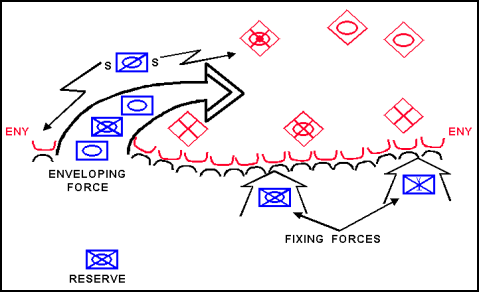
The envelopment is the art of avoiding your enemy's strength and attacking where they are weakest. Instead of crashing headlong into a fortified position, you maneuver around it.
Say you’re competing for a promotion. Everyone else is padding their resume with the same credentials, attending the same networking events, and pitching themselves the same way. That's a frontal assault on a fortified position. The formidable find the flank.
In military doctrine, the envelopment avoids the enemy's main strength and strikes an assailable flank. The fixing force pins them in place while the enveloping force maneuvers to a position of decisive advantage. In business and life, this means identifying what everyone else is doing head-on and deliberately choosing a different axis of approach. Solve the problem no one else is solving. Serve the customer and market everyone else ignores. Build the capability that makes you impossible to compare.
Where in your career or business are you grinding frontally when a flanking route exists?
STOP COMPETING WHERE THEY'RE STRONGEST. MANEUVER TO WHERE THEY'RE EXPOSED.
Technique: The Turning Movement
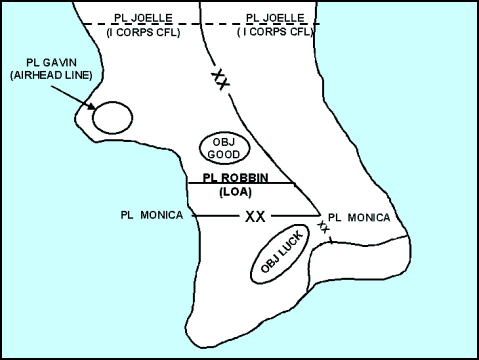
The turning movement bypasses the enemy's position entirely. Instead of attacking their front or flank, you strike deep into their rear, threatening something they cannot afford to lose. This forces them to abandon their prepared position and fight on your terms.
Your competitor dominates the market with an established product. Competing feature-for-feature is a frontal assault. Instead, you build something that makes their entire model irrelevant. You don't fight for their customers. You redefine what customers need.
The turning movement in doctrine targets objectives deep behind enemy lines, logistics hubs, command nodes, supply routes. The enemy must turn from their fortified position to protect what matters most, and in doing so, they expose themselves. In business, this means bypassing the competitive landscape entirely. Don't build a better mousetrap. Eliminate the need for one. Create the product, service, or capability that makes the existing competition irrelevant.
What position could you take that would force your competition to react to you instead of the other way around?
DON'T FIGHT THEIR BATTLE. MAKE THEM FIGHT YOURS.
Procedure: Infiltration
Infiltration is the most patient and deliberate of the three concepts covered in this edition. Small elements move undetected through gaps in the enemy's defenses, assembling on the other side to strike from within. No grand maneuver. No dramatic flanking action. Just quiet, relentless penetration.
You want to break into an industry dominated by established players. You don't launch with a massive campaign or try to outspend them. You start small. You find the gaps they aren't watching. You build relationships, credibility, and presence in spaces they've overlooked. By the time they notice you, you're already inside.
Watch this: a guy named Forest moved to Billings, Montana knowing nobody. He started a wholesale snack distribution business by calling competitors, identifying gaps the big wholesalers ignored, and walking into gas stations with one product. No grand launch. No massive campaign. Just quiet, relentless penetration into a market dominated by national distributors. He started each store with a single jerky rack. Within a year, some of those stores carried over 100 of his products. He infiltrated through the seams, built from within, and scaled to $60,000 a month. That is textbook infiltration.
(Credit: Chris Koerner, The Koerner Office Podcast)
Military infiltration exploits seams, boundaries between units, gaps in coverage, periods of reduced readiness. Small teams move through undetected terrain with specific objectives. In business and career, this is the strategy of strategic patience. Enter through the gaps. Build quietly. Accumulate advantage where no one is looking. When you finally reveal your position, you're already too embedded to dislodge.
Where are the seams in your industry that no one is covering?
THE BEST POSITION IS THE ONE THEY DIDN'T KNOW YOU WERE TAKING.
Inspirational Exemplar: Hannibal Barca at Cannae

Hannibal's double envelopment at Cannae, 216 BC. (Dept. of History, USMA)
216 BC. Rome sends 86,000 men to crush Hannibal's army of 50,000 at Cannae. The Romans advance in a dense, deep formation, confident their numerical superiority will shatter the Carthaginian line. It is a textbook frontal assault.
Hannibal lets them come.
He places his weakest troops at the center, deliberately allowing them to bend backward under the Roman push. The Romans surge forward, believing they are winning. They compress deeper into the concave pocket forming around them. Then Hannibal's heavy African infantry on both flanks pivots inward, and his cavalry, having routed the Roman horsemen, slams into the rear.
The envelopment is complete. 86,000 Romans are surrounded. Nearly 70,000 are killed or captured in a single afternoon. It remains one of the most devastating tactical victories in the history of warfare.
Hannibal didn't win by having more. He won by refusing to fight where the Romans were strongest and designing a battle that turned their aggression into their destruction. The Romans did exactly what he wanted them to do.
Formidable operators don't match force with force. They design the conditions where the enemy's strength becomes their weakness.
Outbrief
The formidable don't win by fighting harder. They win by fighting smarter.
This week we covered three ways to stop grinding and start maneuvering:
The Envelopment: avoid their strength, strike the flank.
The Turning Movement: bypass entirely, threaten what they can't lose.
Infiltration: move through the gaps, build position before they notice.
And from Hannibal at Cannae, the ultimate lesson: let the enemy's own momentum become the instrument of their defeat.
Stop competing head-on. Find the indirect approach.
Until next time, stay formidable.
*For more resources, services, and ways to connect — check out everything I have going on here
**And if you're looking for a practical tool to keep your notes, plans, and strategies sharp and organized, I recommend picking up the Lockebook - a minimalist, military-inspired notebook designed to streamline your thinking and keep your goals front and center.
Thank you very much for reading.
Genuinely,
Ryan "DQ" DeQuiroz
Reply